

Bharat rises to No 3 in Asia’s power rankings; But what does it really mean?
Bharat crossed threshold that Lowy calls major power status, a benchmark that reflects not just momentary events but structural national capabilities
Bharat rises to No 3 in Asia’s power rankings; But what does it really mean?
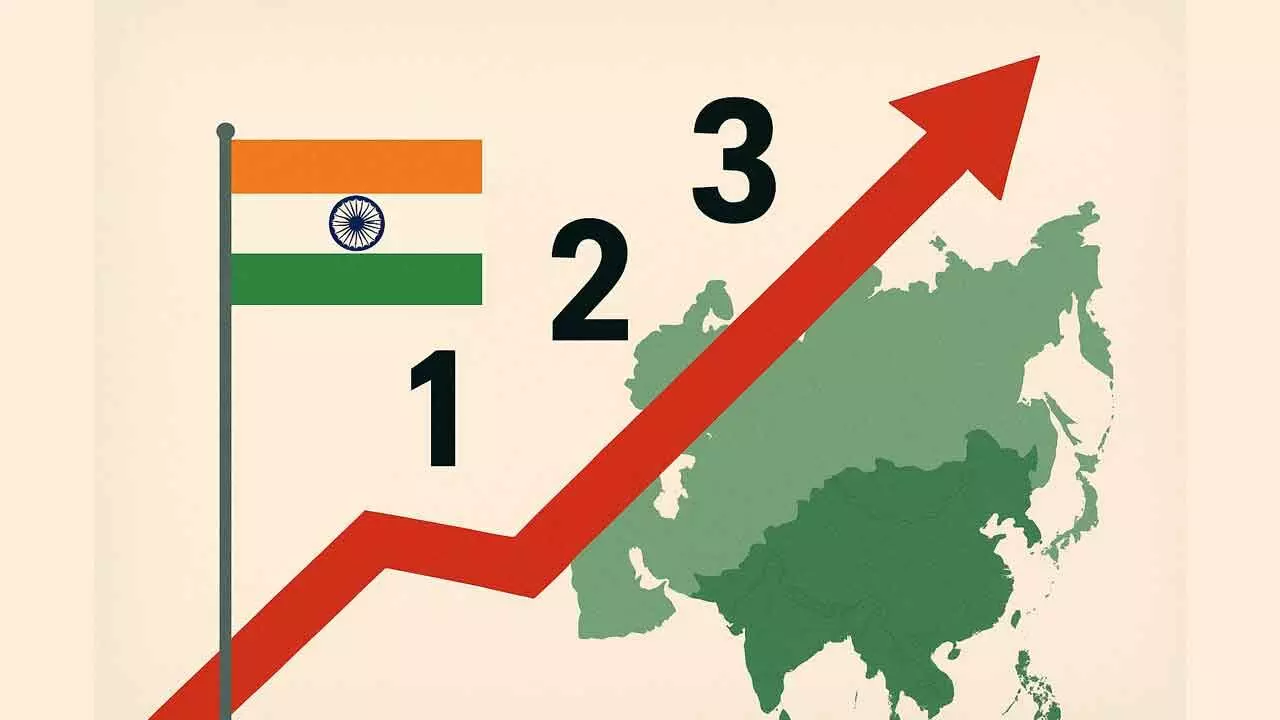
Bharat received notable recognition this year when the Lowy Institute, a prominent Australian think tank, ranked the country third in Asia's Power Index, behind only the United States and China. For the first time, Bharat crossed the threshold that Lowy calls "major power status", a benchmark that reflects not just momentary events but structural national capabilities.
The ranking made headlines across foreign-policy circles because it captures a significant shift: Bharat is no longer merely a ‘rising’ power. It has risen. But what lies behind the ranking? And should India really care?
What Is the Asia Power Index?
The Asia Power Index is an annual study that evaluates 27 countries and territories across the Indo-Pacific—from Pakistan to Japan and from Russia to Australia. The idea is to measure a nation's influence in the region, using data and expert assessments rather than mere opinion.
Lowy evaluates power under eight major categories:
Economic Capability – GDP size, technological advancement, strategic industries
Military Capability – defence spending, hardware, readiness, combat experience
Resilience – political stability, energy security, disaster readiness
Future Resources – demography, education, innovation
Economic Relationships – trade networks, investment influence
Defence Networks – alliances, military cooperation, interoperability
Diplomatic influence – global footprint, multilateral activity
Cultural Influence – media presence, people-to-people ties, soft power
In total, the Index uses 131 indicators, many based on internationally recognised datasets (World Bank, IMF, SIPRI) and some on original Lowy research. Because the report is highly structured and transparent in its methodology, it has gained global legitimacy in academic and policy circles.
Bharat ranks No. 3 in Asia
India's rise to the third spot is not entirely new; it has hovered near the top tier for several years. But this time, the decade-long transformation under Prime Minister Narendra Modi ensured Bharat crossed the symbolic 40/100 comprehensive power score, which Lowy considers the threshold for "major power” status.
This is significant because it puts India in a league of its own, distinctly above Japan, Russia, South Korea and Southeast Asian economies. The United States continues to dominate the Index, followed by China, but the gap between China and India remains substantial — India scores roughly half of China's total in overall power.
Still, India's position is an important reminder that New Delhi is now central to any conversation on Asian geopolitics.
What drove Bharat's higher score this year?
1. Bharat's Economy Is Now a Structural Driver of Power
Bharat remains one of the world's fastest-growing major economies. India's economic scale, emerging technological capabilities, and growing economic relevance in Asia are key drivers of its rise.
One point that stands out is long-term foreign direct investment (FDI). Over a ten-year period, India has attracted more FDI than China, making it Asia's second-most attractive investment destination after the US. This reflects the global shift of multinational companies relocating supply chains to India or hedging against China's dependence. Economic weight is often the foundation for national power, and this long-term trend works strongly in Bharat's favour.
2. Bharat's Military Capability Has Improved — With Influence From Operation Sindoor
Lowy explicitly notes that perceptions of Bharat's military improved this year, likely influenced by India's performance in Operation Sindoor, conducted in May 2025.
Operation Sindoor, launched after the Pahalgam terror attack, involved:
• Precision missile strikes
• Drone-based surveillance
• Coordinated air and ground operations
• Long-range targeting systems
• Enhanced jointness across Army, Navy and Air Force operations
For military and geopolitical observers, the operation demonstrated that Bharat is now willing and capable of executing rapid, targeted, and high-precision punitive strikes, while managing escalation and maintaining international legitimacy. These developments could have strengthened Bharat's power ranking.
3. Improved Economic Relationships
For the first time since 2018, Bharat improved its economic relationships, as reflected in trade volumes, FDI flows, and regional integration.
Bharat remains a smaller trading power compared to China or Japan, but its growing role in supply chains, connectivity projects, and economic diplomacy helped push the score upward. This is particularly significant in a region where economic influence often translates into political leverage.
Where India still falls behind: The power gap
Lowy also highlights problems; it says that India's influence remains "well below the potential of its resources." This gap appears in several areas:
1. Diplomatic Under-Representation
Bharat's diplomatic corps is relatively small for a country of its size and ambition: fewer embassies, fewer diplomats, and limited outreach in multilateral forums lower India's diplomatic influence score.
If New Delhi aims to make a meaningful global impact, it must address this anomaly by strengthening its foreign services machinery. Under the able leadership of Foreign Minister S. Jaishankar, Bharat can expand its diplomatic corps, ensuring that the country produces a larger pool of well-trained, globally attuned diplomats in the years ahead.
2. Weak Defence Networks
Unlike US-allied nations, Bharat avoids formal military alliances due to its doctrine of strategic autonomy.
While this is a deliberate policy choice, Lowy's metrics naturally favour alliance-heavy nations such as Japan and Australia. Thus, India scores low in defence partnerships and interoperability. In recent years, New Delhi has sharply increased interoperability with other nations through military drills and exercises. However, India has deliberately avoided full commitment to a military alliance—whether the Quadrilateral Security Dialogue (QUAD) or other arrangements—because of its longstanding doctrine of strategic autonomy. Given New Delhi's stance on strategic autonomy, Bharat may not gain on this front in the coming years.
3. Limited Cultural Penetration
Despite Bollywood, yoga, Ayurveda, and a vast diaspora, Bharat's cultural influence does not always translate into measurable indicators such as media exports, brand visibility, or language spread. As a result, the Index assigns India only a modest score on cultural influence. This is where private organisations, creators and influencers can play a stronger role. The recent global buzz around the Kantara movie from Karnataka—an authentic portrayal of a unique tradition deeply rooted in ancient culture—resonated strongly with global audiences. Similarly, Ram Charan's Chikrik song, along with the wave of international covers and performances it inspired, shows how viral cultural moments can significantly boost Bharat's soft power. Such flashes must occur more frequently. What India needs now is a coordinated global media and influencer ecosystem that can consistently take Bharat's culture, music and stories to audiences worldwide.
4. Underuse of regional leverage
Lowy implies that India's large economy and military should translate into more decisive leadership in South Asia and across the wider Indo-Pacific, but this potential remains unrealised. This mismatch between capability and influence is what Lowy calls India's power gap.
How Credible Is the Lowy Institute's Ranking?
Understanding the institution behind the ranking is important. The Lowy Institute established in 2003 by Frank Lowy, the founder of the Westfield retail group.
Funded by the Australian government, several corporates (such as BHP and Rio Tinto), philanthropic donors, and the Lowy family.
Considered centre-right in orientation but consistently high on factual reporting and research quality.
The Institute is well-respected globally and regularly cited in academic journals, government policy papers, and international media. However, like all think tanks, it is shaped by the worldview of its host country — in this case, Australia. This means some aspects of the Index reflect Western strategic preferences, such as:
• Importance of formal alliances
• Emphasis on free trade
• Focus on conventional military capacity
These may not fully match Bharat's own understanding of power. Still, the Asia Power Index remains one of the most elaborate, transparent, and widely referenced power measurement tools in the Indo-Pacific.
Should India really care about such rankings?
Bharat's foreign policy is about "multi-alignment," thus has always been based on strategic autonomy.
New Delhi has consistently resisted bloc politics and pursued policies based on its interests — from buying oil from Russia, to joining the Quad, to expanding BRICS.
New Delhi does not craft foreign policy to climb an international league table.
However, such rankings are valuable for three reasons: they Influence Global Perception, they provide an External Mirror, and They Reflect Structural Trends.
So while Bharat should not chase rankings, it can certainly use them to fine-tune strategy.
The 2025 Asia Power Index offers three broad takeaways: Bharat is now recognised internationally as one of Asia's top three powers. Its economic and military strengths are widely acknowledged, but its diplomatic and cultural influence still lags behind its potential. For a country that prides itself on its independent foreign policy, this ranking is less a badge and more a mirror.
The report confirms Bharat's growing stature, highlights areas where its influence needs to catch up with its capabilities, and underlines the importance of sustained engagement with the Indo-Pacific order. India has already become a major power. The challenge now is to act like one — consistently, confidently and with strategic clarity.
(The author is Founder of My Startup TV)





